

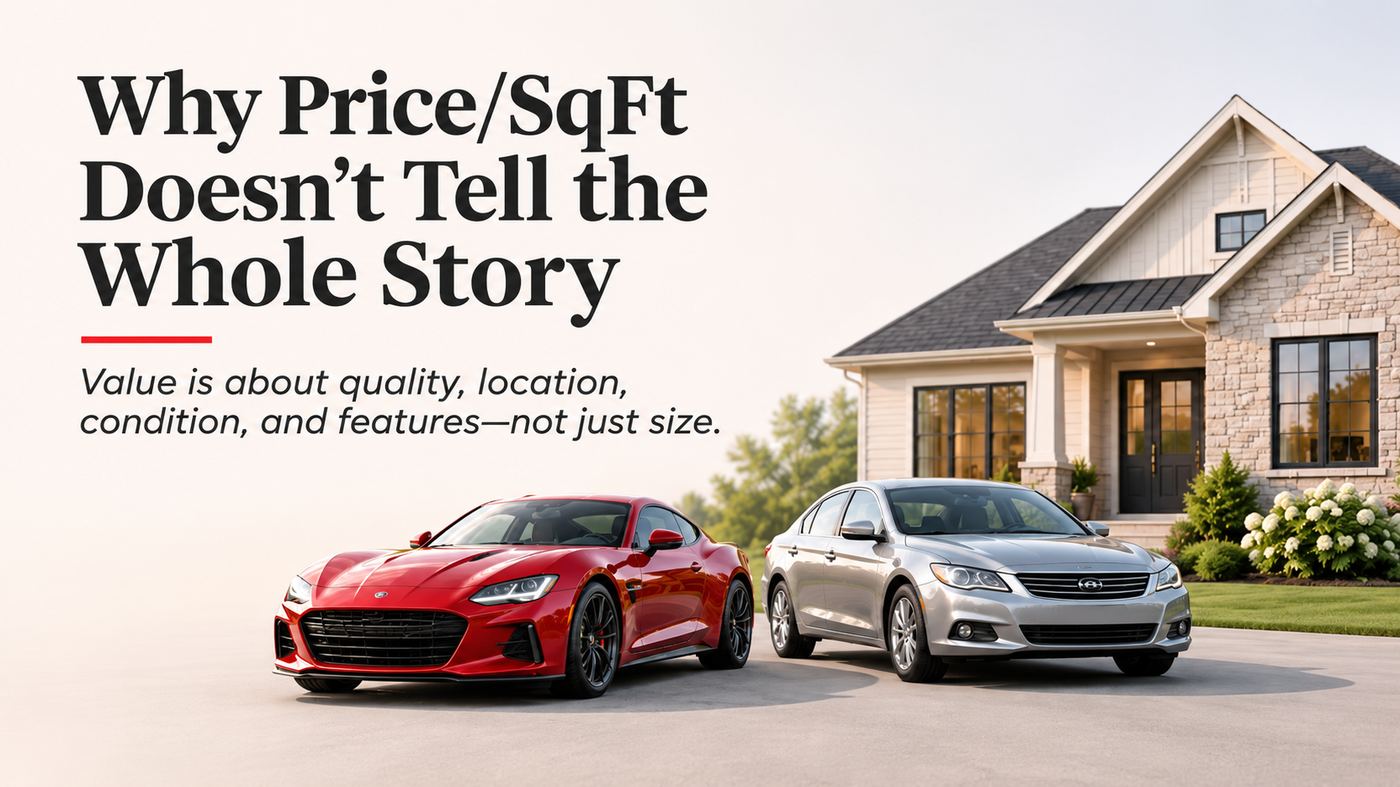
Imagine walking into a car dealership and telling the salesperson you’re looking for a vehicle, but you’ve decided to base your purchase entirely on how much the car weighs.
The salesperson shows you a Porsche 911 and a Chevy Impala. Both weigh somewhere in the same ballpark, so naturally, they should cost about the same, right?
Of course not.
Nobody in their right mind would suggest that a Porsche and an Impala should have the same price simply because they weigh roughly the same. One is a high-performance sports car, and the other is a practical family sedan. They’re built for different purposes, with different materials, features, performance, and overall appeal.
Yet when it comes to real estate, we do something surprisingly similar all the time. We look at price per square foot.
Not all square feet are created equal
Think about the differences between those two cars. The Porsche has a different level of engineering, performance, and craftsmanship. The Impala might have plenty of great features, but that doesn’t make the two vehicles interchangeable.
Homes work the same way. A 2,000-square-foot home with builder-grade finishes isn’t necessarily worth the same as a 2,000-square-foot custom home with high-end materials, thoughtful design, and superior craftsmanship.
Both have 2,000 square feet. But those square feet aren’t necessarily equal in the eyes of a buyer. And that’s before we even talk about location.
It’s all about the brand... sort of
A Porsche comes with a certain reputation, just as different automobile brands carry different expectations. Neighborhoods can work much the same way.
Two nearly identical houses can have very different values simply because of where they’re located. School districts, surrounding properties, amenities, and overall neighborhood appeal all influence what buyers are willing to pay.
You wouldn’t expect a Chevrolet to suddenly command Porsche pricing just because it has the same dimensions. Likewise, you can’t assume two houses should sell for the same price per square foot just because they’re the same size.
Don’t forget the trim package
Cars come in different trim packages: heated seats, upgraded interiors, premium sound systems, performance packages. The list goes on.
Homes have their own versions of trim packages. Finished basements, additional bathrooms, garages, updated kitchens, outdoor living spaces, and other amenities can significantly affect a property’s overall value.
Consider two homes with identical above-grade square footage. One has a full, beautifully finished basement, while the other has an unfinished basement, or no basement at all. Their price per square foot could look dramatically different, even though their above-grade living areas are identical.
It’s not necessarily because one home’s main-level square footage is more valuable. It’s because we’re dividing the entire property’s price by just one part of what the buyer is purchasing. That’s a pretty important distinction.
You can see this in our Dallas County market report: ranch homes show a much higher median price per square foot than two-story homes, largely because so much of a ranch’s finished space is in the basement, which isn’t counted in the square footage.
Mileage, age, and what’s left in the tank
We also wouldn’t value a ten-year-old car with 200,000 miles the same as one with 30,000 miles simply because they’re the same model.
Condition matters. Maintenance matters. And perhaps most importantly, how much useful life remains matters. In appraising, we call this remaining economic life.
Think of it as how much life a property has left before significant improvements or replacements become necessary or its usefulness becomes limited. A well-maintained older home with updated major components might have considerably more remaining economic life than a newer home that’s been neglected.
Just like a car, the year it was built only tells part of the story.
Bigger doesn’t always mean more per square foot
Here’s another interesting twist. A smaller home will often sell for a higher price per square foot than a larger home, even when the quality and location are similar.
Why? Because not every additional square foot contributes the same amount of value. A 1,200-square-foot home still needs a kitchen, bathrooms, heating and cooling, plumbing, and electrical systems. A 2,400-square-foot home doesn’t necessarily need twice as many of those expensive components. As a home gets larger, each additional square foot often contributes less to the overall value.
It’s similar to adding options to a car. Just because you spent another $10,000 on upgrades doesn’t automatically mean someone will pay you $10,000 more when you sell it.
So, is price per square foot useless?
Not at all. It can be a helpful comparison tool when you’re looking at properties that are truly similar in size, quality, condition, location, and amenities.
But using it as the primary method of determining a home’s value? That’s where things can go sideways. Real estate value is about the entire property and what buyers are willing to pay for everything it offers, not just the number of square feet under the roof.
After all, you wouldn’t buy a Porsche by the pound. So why would you value a house by the square foot?